
Showing posts with label Beijing CH. Show all posts

8.7.11

Wangfujing, Beijing

Wangfujing is one of the famous local snack street and night market, in Dongcheng District Beijing. Today we walked from where we stayed and took the subway to Wangfujing...
St. Joseph Chruch

The majority of the main area is pedestrian area and very popular shopping place for both tourists and locals. Since the middle of the Ming Dynasty there have been commercial activities in this place. In the Qing Dynasty, ten aristocratic estates and princess residence were built here, soon after when a well full of sweet water was discovered, thereby giving the street its name "Wang Fu" (princely residence) "Jing" (well). 
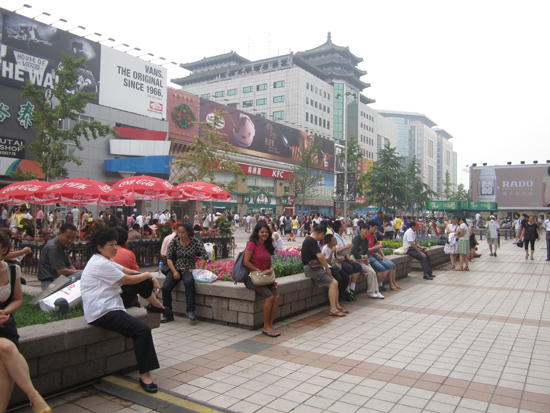
Wangfujing is now home to around 280 famous Beijing brands, such as Shengxifu hat store, Tongshenghe shoe shop, and the Wuyutai tea house & the New China Woman and Children Department Store helped established by Soong Ching-ling (Madame Sun Yat-sen) are also located on the street.
The Wangfujing snack street, located in hutongs just west of the main street, is densely packed with restaurants and street food stalls. 
 dinner was steamboat in one of the department store -food area
it was way too much to handle for both of us, and its a set for 2 person... or is it a set for 2 giants?? 
all and all... it was a worthwhile trip down town!


5.7.11

The Temple of Heaven (Tian Tan), Beijing

The Temple of Heaven, literally the Altar of Heaven (Tiāntán) is a complex of Taoist buildings situated in the southeastern part of central Beijing. The complex was visited by the Emperors of the Ming and Qing dynasties for annual ceremonies of prayer to Heaven for good harvest. It is regarded as a Taoist temple, although Chinese Heaven worship, especially by the reigning monarch of the day, pre-dates Taoism. When I visited this place, I can imagine how the Empress Dowager Cixi prays here (from the book Empress Orchid & Last Empress Dowager by author Anchee Min).
In 1918, The Temple of Heaven was turn into a park,it attracted masses of visitors from home and abroad by the grand scales...
The spacious Temple of Heaven is well-afforested. When going into the Temple, a feeling of solemnity, respectfulness, holiness and quietness will well up in the mind. When looking at the beautiful sacrificial altar, one will feel the his soul is purified and his thoughts sublimed. 
We are both amazed on the activities that locals does here...
Seven-Star stones, during the Ming emperor Jiajing's reign, seven gigantic pacifying stones were placed to the southeast of the Great Hall of Sacrifice. These are stones with motifs of mountains engraved on them and not the meteors as the hearsay went, symbolizing the seven peaks of the Mountain Tai. After the Manchurian came to the throne in central China, in order to show the Manchurian is part of the Chinese nations, Emperor Qianlong issued an edict for another stone to be placed in the direction of the northeast, meaning the Chinese nations are a big family and the country is unified.

Read more about the Tian Tan here

xoxo

4.7.11

The Great Wall of China

Badaling is the site of the most visited section of the Gret Wall of China, approximately 80 km northwest of urban Beijing city. As you might notice from the map of China and from history that the Chinese has built great walls to protect them-self from the outside world. The portion of the Badaling wall running through the site was built in 1505 during the Ming Dysnasty. The highest point of Badaling is Beibalou, approximately 1,015 metres above sea level.


Badaling and the expressway were the site of the finishing circuit of the urban road cycling course in the 2008 Summer Olympics. 


thank you all for stopping by and viewing the post...
xxx

3.7.11

Palace of Tranquil Longevity

Its day two visit to The Forbidden City, we have to visit the Treasure Hall (Palace of Tranquil Longevity). Located on the east side of the Forbidden City in the corridors surrounding the Hall of Imperial Supremacy (Huangji dian), the Hall of Cultivating One's Character (Yangxing dian), the Hall of Joyful Longevity (Leshou tang), and in the Belvedere of Well-nourished Harmony (Yihe xuan).

The Palace of Tranquil Longevityliterally, "peaceful old age palace," also called the Qianlong Garden, Qianlong Palace, Qianlong District or the Palace of Tranquility and Longevity. Located in the northeast corner of the inner court of the Forbidden City. Construction of the palace began on the Qianlong emperor's orders in 1771, in preparation for his retirement, although Qianlong never moved into the palace. Its beautiful apartments, pavilions, gates and gardens feature "some of the most elegant spaces at a time widely considered to be the pinnacle of Chinese interior design.Throughout the Qing period, the palace was almost never used, largely because of Qianlong's imperial decree ordering his retirement retreat remain unaltered.

The central bridge is reserved for emperors exclusively. The two flanking it are reserved for royal family members while the two outer ones are for ordinary officials. The bridges are well decorated with marble balustrades carved with motifs of dragon and phoenix.


thank you all for stopping by...
xxx

The beginning of the new month and a question on how though I can be!

Last month accident cost me weight lost! All those meds are crazy!  Still here and still doing pottery for a  living! broken arm didn't ...